

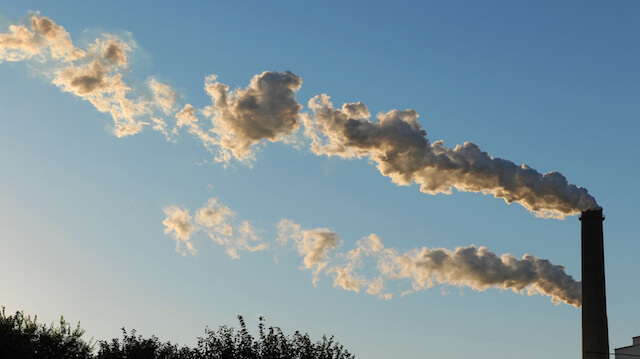
An early champion of environmental rights, Native American leader named Chief Seattle wrote that “Man does not weave the web of nature, he is merely a strand in it.”
That powerful thought came to mind as scientists at the Commonwealth Scientific and Industrial Organisation (CSIRO) announced that CO2 emissions in the Southern Hemisphere had surpassed a symbolic — but perhaps critical milestone — of 400 ppm.
CSIRO’s findings, alarming in themselves, are merely the latest in a series of disconcerting reports on the state of global warming. NASA, for instance, recently released data showing that the earth’s average temperature has set record highs over the last seven months. In fact, 2015 was the hottest year ever recorded. And if trends set early this year continue, then 2016 could be even more of a scorcher.
Ninety-seven percent of climate scientists agree global warming is real, human-caused and a threat to our planet. CO2 emissions, which trap greenhouse gasses, are heating the atmosphere, leading to rising sea levels, acidic oceans, melting polar ice caps, glacial retreat and higher surface temperatures for the planet . As a result, climatologists predict more extreme weather events. The repercussions for the earth’s inhabitants include coastal flooding, widespread droughts, the disruption of delicate ecosystems and widespread species extinction.
Despite abundant warning signals and overwhelming evidence — in the form of dying coral reefs, glacial meltings and record-setting heat waves — some political and corporate factions resist the idea that our fossil fuel habits are implicated in the ominous weather patterns we experience.
Human beings often are surprisingly slow to respond to existential ecological threats. The anthropologist Jared Diamond, for example, relates a story about the inhabitants of Easter Island, who mysteriously vanished following the deforestation of their local habitat. Pondering their fate, which was almost certainly caused by unwise resource management, Diamond poses a question that undoubtedly has implications for us: What went through the minds of the natives as they cut down the very last tree?
“Those who fail to learn from history are doomed to repeat it” goes a adage. There is abundant evidence that Mayan, Aztec and Viking civilizations collapsed largely because of ecological pressures. The Roman empire too, which lasted for 1,000 years, was undoubtedly undone by a mixture of social inequality, civil strife and official corruption. However, recent scholarly interest has focused on environmental factors — more specifically, drinking water tainted by lead pipes — as a key reason for Rome’s downfall.
If both history and science are reliable guides, then we would be well advised to take both immediate individual and collective action to change our energy consumption habits, which are slowly but surely threatening the planet.
Climate change skeptics claim that measures to limit fossil fuel consumption will crimp economic growth and undermine standards of living. Some insist that international agreements and regulatory frameworks aimed at curtailing CO2 emissions are a government plot aimed at empowering bureaucrats at the expense of citizens.
Although the concerns reflected in these arguments are not without some merit, by any measure the risks of failing to act on climate change are simply too great to ignore. Maintaining the status quo, in all probability, will lead to more super storms, the drowning of coastal cities and higher rates of droughts and famines.
According to James E. Hansen, a retired NASA climate scientist who now heads a research center at Columbia University, “we’re in danger of handing young people a world that’s out of their control.” Citing a study in the journal Atmospheric Chemistry and Physics, Hansen argues that the drastic shifts forecast are perhaps decades — not centuries — away. Specifically, Hansen fears that humanity will lose many of its major coastal cities within the next 50 years unless we take dramatic action now to reduce carbon emissions.
It’s clear that the vast majority of scientists believe that elevated CO2 emissions we’ve witnessed recently could push us beyond an irreversible tipping point. A vicious cycle, in which melting glaciers stall the Gulf Stream currents, could disrupt the process known as thermohaline circulation, which has kept temperatures in a range hospitable for much of civilization. This is the kind of negative climatic feedback loop that could displace millions through rising sea levels and inclement weather across the globe.
On the other hand, widespread investment in renewable energy sources could tip both our planet and the world’s economy in a better direction. After all, historically speaking, adoption of more efficient forms of energy has invariably been associated with more prosperous and ascendant civilizations.
Ironically, fossil fuels consist of solar energy, which is trapped in the remains of once living creatures. In our ravenous thirst for energy, we expend great effort to acquire and hoard these supplies. Resource wars and catastrophic weather events are two of the byproducts of our addiction to carbon-based fuels. Harnessing the power of the sun’s ray directly would represent a cleaner, more efficient and morally justifiable alternative to our unsustainable fossil fuel habit, which poses a threat to our children and grandchildren.
Chief Seattle urged us to think not just of ourselves, but the web that connects us all. It’s the kind of wise thinking we need as we confront the environmental choices that will determine our planet’s future.
-Scott O’Reilly
Sources:
http://climate.nasa.gov/evidence
http://www.smh.com.au/environment/climate-change/confirmed-southern-hemisphere-co2-level-rises-above-symbolic-400-ppm-milestone-20160515-govfq7.html
https://sites.google.com/site/teachingenvironmentalhistory/the-fall-of-the-roman-empire
http://www.nytimes.com/2016/03/23/science/global-warming-sea-level-carbon-dioxide-emissions.html?_r=0
http://www.atmos-chem-phys.net/16/3761/2016/acp-16-3761-2016.pdf
http://www.resilience.org/stories/2006-12-02/energy-resources-and-our-future-remarks-admiral-hyman-rickover-delivered-1957


The above article – hilarious. Al Gore part deux!! Notice how all our cities are now under water as he predicted. Global warming – biggest scam in history designed to keep the under classes and those in need down . Imagine what the 150 billion from Obama to feed the myth could have been used for. CO2 the building block of life – the sea releases it in response to solar sun spots. It doesn’t cause warming . It causes growth. Wind farm materials use incalculable amounts of energy to cast the materials used in them. And they are totally unreliable- no storage facility and only work when there is wind- hence each wind farm needs a back up generator. – which needs a relative(to the wind farm) tiny space to produce the same electricity. 97 % of scientists!!! Absolute nonsense and those who are on the gravy train of GW are half wit nobodies with little or no scientific backgrounds.No scientist worth his salt signs up to the myth. Enough please
Kevin, thanks for reading my article, but sorry if you don’t find global warming to be a genuine threat. The 97% figure I quoted is from NASA’s own site — I would think they have some credibility. By the way, Gore’s prediction about cities being underwater is in 50 to 100 years. Glaciers are melting and sea levels are rising. I think it’s very likely he will be proven correct.
Criticisms of Al Gore’s “An Inconvenient Truth”
Al Gore’s An Inconvenient Truth became a big part of the British secondary educational landscape when it was made part of the official curriculum. This was big victory for those who feel the world is in imminent danger because of anthropogenic global warming. However, the High Court of London recently said “not so fast.” Steward Dimmock sued under Section 406(1)(b) of the Education Act 1996, claiming that the movie is a form or political indoctrination. That law says that school governing bodies and head teachers “shall forbid… the promotion of partisan political views in the teaching of any subject in the school”.
The court ruled that 1.) in order to show this movie to the children teachers must make clear that the film is a political work and promotes only one side of the argument. 2.) If teachers present the film without making this plain they may be in breach of section 406 of the Education Act 1996 and guilty of political indoctrination. 3.) Nine inaccuracies have to be specifically drawn to the attention of school children.
I will use these nine cited inaccuracies as a jumping off point for my criticisms of An Inconvenient Truth, both the book and film. These nine inaccuracies are:
The film claims that melting snows on Mount Kilimanjaro evidence global warming. The Government’s expert was forced to concede that this is not correct. more… The film suggests that evidence from ice cores proves that rising CO2 causes temperature increases over 650,000 years. The Court found that the film was misleading: over that period the rises in CO2 lagged behind the temperature rises by 800-2000 years. more… The film uses emotive images of Hurricane Katrina and suggests that this has been caused by global warming. The Government’s expert had to accept that it was “not possible” to attribute one-off events to global warming. more… The film shows the drying up of Lake Chad and claims that this was caused by global warming. The Government’s expert had to accept that this was not the case. more… The film claims that a study showed that polar bears had drowned due to disappearing arctic ice. It turned out that Mr Gore had misread the study: in fact four polar bears drowned and this was because of a particularly violent storm. more… The film threatens that global warming could stop the Gulf Stream throwing Europe into an ice age: the Claimant’s evidence was that this was a scientific impossibility. more… The film blames global warming for species losses including coral reef bleaching. The Government could not find any evidence to support this claim. The film suggests that sea levels could rise by 7m causing the displacement of millions of people. In fact the evidence is that sea levels are expected to rise by about 40cm over the next hundred years and that there is no such threat of massive migration. The film claims that rising sea levels has caused the evacuation of certain Pacific islands to New Zealand. The Government are unable to substantiate this and the Court observed that this appears to be a false claim. I REST MY CASE
Share this:
PrintEmailFacebook12
Kevin, thanks for your detailed response and the info regarding some problems with Gore’s film. I try to look at all the evidence and weigh strengths and weakness on both sides. I believe there is an abundance of evidence on Climate Change that goes well beyond Gore’s film — just check out NASA’s web site (cited in my article). Once again, thanks for reading my article and for sharing your comments