

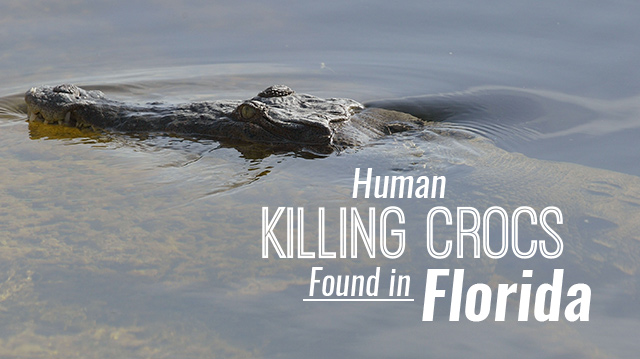
Nile crocodiles are estimated to kill hundreds of people a year in Africa, where they live naturally. Now they have now been found in Florida, a state already bulging coast-to-coast with invasive, foreign plants and critters.
The Nile crocodile is native to sub-Saharan Africa and can be found living in lakes, marshlands and rivers. Full-grown adult males range in size from 11.5 feet long to 16.5 feet long and generally weigh in between 500 and 1,200 pounds. It is the second-largest crocodile in the world; only the notoriously aggressive saltwater crocodile is larger.
Despite being less aggressive than its saltwater cousin, the Nile crocodile kills far more people. The estimated number of attacks from Nile crocodiles per year range between 275 and 745 and more than 60% of attacks are fatal. Moreover, attacks often are not reported, making it difficult to obtain complete data.
DNA testing carried out by researchers at the University of Florida confirm that four crocodilian species captured near Miami are indeed Nile crocodiles. The testing concluded that the crocs are not related to any of crocs in captivity at nearby zoos, but that the reptilian quartet’s members are related to each other. Researchers believe that the animals were brought to Florida illegally, possibly as part of an exotic pet operation.
One of the animals was caught in 2012 and released back into the wild, which allowed a team to study its growth and ability to survive in Florida’s Everglades. The crocodile was re-captured two years later and found to have grown 28% faster than a crocodile its age would under normal circumstances. This led researchers to speculate that the conditions in Florida are very accommodating to the Nile crocodile and that there is great potential for the species to be able to survive and thrive in the Everglades.
Shocking, another of the crocodiles was captured on the front porch of a Miami home.
Burmese python
The discovery yet another top of the food chain, “apex” predator from far away living in the wilds of Florida draws comparison to the Sunshine State’s Burmese python invasion.
Native to the tropical areas of Southeast Asia, the Burmese python averages 12 feet in length, can grow as long as 19 feet and is the second-largest snake on the planet.
In 2012, the U.S. Department of the Interior issued a ban on importing Burmese pythons, but by then the population had been established in the Everglades. Estimates of python population numbers are difficult to determine, researchers believe that at least 30,000 of the giant pythons now living in the swamps west of Miami and Fort Lauderdale.
Native mammal populations have been devastated as a result of invasive pythons. Surveys conducted near the Everglades between 1996 and 2011 saw 88% to 100% reduction in mammals such as possums, raccoons, fox and rabbits. Dietary records show that the Burmese python will eat even American alligators, which can grow as large as 15 feet.
It is believed that the pythons were brought to the area illegally and sold as pets. When these large pets later prove difficult to care for they are released into the wild, where they thrive and multiply.
Exotic pets and Florida
Animal species ranging from small reptiles all the way to full-grown tigers can be purchased on the global black market. Florida is considered a hub for this underground industry. In the United States alone it is estimated that illegal wildlife trafficking is a $15 billion dollar business. The animals are either kept as exotic pets or often are put on display as part of roadside zoos.
The most popular animals on the black market include snakes, exotic birds, big cats (especially tigers), turtles and monkeys.
What makes Florida particularly susceptible to released animals thriving in the wild is that the climate is similar to where many of these animals originate. Researchers believe there to be at least 50 confirmed invasive species breeding in Florida, at least 40 of them lizard species and between four and five snake species.
How big a problem are the new crocs?
It is not known if there are more Nile crocodiles in the Everglades, though researchers state that considering the relatively small number of people looking for them that it is unlikely that the four captured so far are the only ones out there.
The researchers say there have been no signs that the crocs are breeding, but also that it would take just one male and one female finding each other to establish an invasive population. Romantic, perhaps. But also ecologically disastrous.
Wildlife biologist Joe Wasilewski, who co-authored the paper that released the DNA results, believes that there is cause for concern that the Nile crocodiles could become an invasive breeding species in the Everglades.
“I have two words for you: Burmese python. If you would have told me 15 years ago we would have an established population in the Everglades, I wouldn’t have believed you,” Wasilewski says.
– Ian Carey
Sources:
http://www.herpconbio.org/Volume_11/Issue_1/Rochford_etal_2016.pdf?version=meter+at+4&module=meter-Links&pgtype=article&contentId=&mediaId=&referrer=https%3A%2F%2Fwww.google.ca%2F&priority=true&action=click&contentCollection=meter-links-click
http://animals.nationalgeographic.com/animals/reptiles/nile-crocodile
http://www.livescience.com/54830-nile-crocodiles-in-florida.html
http://animals.nationalgeographic.com/animals/reptiles/burmese-python
http://america.pink/burmese-pythons-florida_792235.html
http://edis.ifas.ufl.edu/uw365
http://www.cbc.ca/news/technology/nile-crocodiles-florida-1.3596481


Maybe they should use the crocs to help control the pythons.
If only :p Then we can feed the lion fish to the crocs, too.
What a mess!
Emphasis seems to be on the argument that these animals were imported illegally. Maybe. But for decades, FLA was the hub for the legal importation of countless species of exotic animals destined for sale in the pet trade, and shipped out all over the country. Nile crocodiles were one of those species, including American Crocodiles (from Mexico and South America), Salt Water Crocodiles, Siamese Crocodiles and West African Dwarf Crocodiles. To assume that these crocs can’t be the descendants of escaped/liberated crocodiles from the 1960’s or 1970’s is probably naive. Anyone seeing one would likely think it an Alligator submerged in the muddy water. The Everglades could easily support almost any of the reptiles imported during the 60’s and 70’s. Like most wild animals, they’d submerge themselves in the water at the slightest hint of human activity. Look also for Caimans (South American cousin to the Alligator), Boa Constrictors, Anacondas, Reticulated Pythons and even Cobras and Mambas–a couple of years ago, a handyman in FLA was bitten by a large, green snake that turned out to be a East African Green Mamba. Luckily, the Miami Serpentarium had anitivenin for this bite and the man recovered. Stay tuned…
I’m going to explain to you how you race-baited with this article, The Alternative Daily, because you probably didn’t realize you did it. Human-eating AFRICAN Crocs Found in Florida! Wow! Africanized bees, Zika mosquitoes, AIDS, and now crocodiles coming to America killing (and eating) innocent people. Even the article states that the saltwater croc is more aggressive, but the AFRICAN croc is the “bad” one because it kills more people. Duh! It’s in Africa where people are around crocodiles more frequently. Which is stated in the Wikipedia article from which most of the facts in this article were taken, line by line (that one was skipped). When you write headlines like this one, it not only plays to the fears of certain people, it intentionally associates danger and badness to Africa, or black or African-American. Would the article not be just as true with the headline, Nile Crocs Found in Florida? Would the story not be just as true with the removed information from Wikipedia, “While these two species are much more aggressive towards people than other living crocodilians (as is statistically supported by estimated numbers of crocodile attacks), Nile crocodiles are not particularly more likely to behave aggressively to humans or regard humans as prey than saltwater crocodiles. However, unlike other “man-eating” crocodile species, including the saltwater crocodile, the Nile crocodile lives in close proximity to human populations through most of its range, so contact is more frequent.” I respect most of your work, but this is sensationalism and offensive to me.
Race-baited….? Really? Your reaching for something that is not there….Have you ever been to Africa?? Your opinion is racist, if you associate African crocs with black people, aids, and killing.
Why do I need to have been to Africa to have an opinion about how America and European countries demonize Africa with fear-mongering sensationalized stories? Not Bees – Africanized Bees. Not Nile Crocs – Human-eating African Crocs. I do understand that these things aren’t as easy for you to be offended by because you come from a different worldview, but this is my feeling coming from my worldview. You don’t have to be offended by it, but it’s dismissive and assumes to tell others what they can and can’t be offended by, it also assumes that your worldview is the “correct” one. In NO WAY did I associate AIDS and killing with Africa. I’d say to reread my comment without any assumptions about me or race in general, but based upon your comments, you don’t seem ready to objectively take a look at views opposed to yours without resorting to distorting or name calling.
I didn’t call you any names, I just don’t know why something is considered racist if “African” is used as a reference point. The reason I asked if you’ve been to Africa is because there are a lot of Americans and Europeans that live in Africa…..it’s not all tribes like you see in National Geographic. And the Nile River is in Africa. My worldview is that I don’t assume that all people are stupid or sensitive and can read an article about crocodiles and not assume that because the word “African” is in the article that the meaning of the story is racist and all white people are out to get black people. I also know many black people that are African descent and are not offended by the terms black or African…..it is what it is….I’m white..or Irish..or German…God only knows. Heinz 57! Should we change the name of the “African Elephant” to just Elephant?? It’s from Africa, African Elephant. Umm. not racist.