

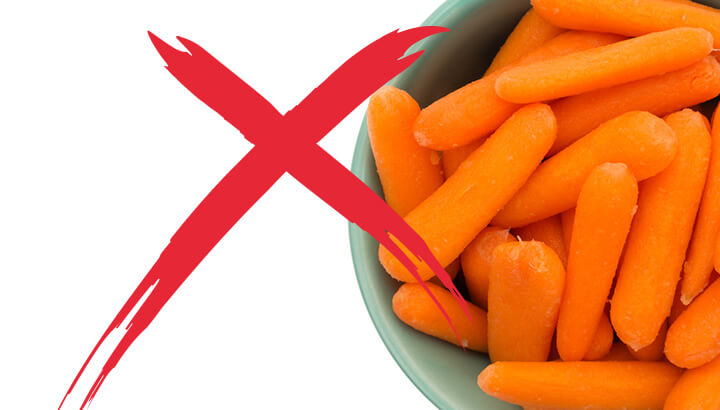
E. coli Outbreak Linked to Organic Carrots
Breaking News: November 17, 2024 Update – CDC and public health officials in several states are investigating a multi-state outbreak of E. coli O121 infections linked to multiple brands of recalled organic whole bagged carrots and baby carrots sold by Grimmway Farms. Carrots on store shelves right now are likely not affected but may be in people’s homes. If you have any recalled carrots in your home, throw them out or return them to the store. Click here to read more. =>
We’ve all chomped on a cute baby-cut carrot or two. After all, they’re so convenient, aren’t they? Baby carrots are usually included in a raw vegetable platter and sold by the bagful, finding their way into many children’s lunches, day-in and day-out. It seems like they are a great, healthy snack, right?
Sure, they may be adorable — but I wouldn’t touch them. I wouldn’t even give them to my carrot-loving pug, Moe. Years ago, my grandma told me to avoid this rather unnatural-looking snack. I mean, when you look at a carrot, straight from the ground, it certainly differs from the little, watery “nubs” you get in a bag. What are these miniature carrots and why should we avoid them?
Where do baby carrots come from?
For all of you mothers out there that feed your children baby carrots, you know that they tend be favored over old-school carrot sticks. After all, they’re the perfect size and sweeter than your average cut-up carrot. All you need to do is cut open a bag, and voila — a well-loved, snack is prepared. Slather them in heavily processed dip and away you go.
When you really think about it, how are they so different? How is it that these carrots have perfectly rounded edges? They don’t seem to have a core, and they are in fact, sweeter.
The reasons why these carrots are better left on the shelf will be discussed momentarily. But before we get into that, I just want to say that these baby carrots weren’t always questionable. In fact, California farmer, Mike Yurosek, was quite inventive and forward-thinking when he first began the baby carrot revolution.
Originally, he was tired of throwing away so much produce, based on aesthetic imperfections. Food waste gives me a pit in my stomach — so, power to him! After sending imperfect, fully grown carrots through an industrial green bean cutter, then potato peeler, the baby-cut carrot was born. Farmers and carrot lovers unite! Mike found a solution that benefited both him and his consumers.
Exclusive: Top 35 Foods You Should Be Eating
Baby carrots are heavily processed
Although you can find baby carrots (essentially very young carrots), they are often slightly less nutritious than fully mature carrots. On the other hand, baby-cut carrots go through quite the harvesting and processing routine. It is during this production process that these carrots go from a healthy, alternative snack, to somewhat of a large-scale, money-making science experiment.
I grew up in a family that grew their own vegetables. From pumpkins to onions, I was very fortunate to have parents that put nutrition first, teaching us so much about the natural world and what it has to offer us. To get the most out of what it offers, you need to respect it in its natural form. To me, carrots rinsed with chlorine are weird — to say the least. Yeah, spoiler alert: baby carrots get a chlorine shower. N-A-S-T-Y.
Why you should avoid baby carrots
I already spilled the beans a bit on that one, because yes, baby-cut carrots are rinsed in chlorine. Why, you ask?
Before the final rinse, these pre-cut carrots are given a chlorine rinse in order to avoid bacterial growth and ultimately, food poisoning. Unfortunately, this is true, even for organic varieties. Although companies claim that the amount of chlorine is well within the set limits, being comparable to what we find in our tap water, parents haven’t been too pleased.
At the end of the day, based on how they’re pre-cut, companies have to take the necessary steps in order to prevent issues, especially in terms of E.coli. So, when you really think about it, the risk surrounding food-borne bacteria is something we have created. Carrots don’t have to be prepared this way — but they are, based on convenience. Which is also why such a large percentage of the population is living off processed foods. We’re addicted. Companies get richer, as the unaware public becomes sicker.
What’s the solution?
Yes, the fact that baby carrots are rinsed in chlorine makes your skin crawl a bit. However, it’s not the only food that is treated in this manner. Any pre-cut vegetables go through a similar process — even organic salad mixes. It’s a sad reality, as we continue to move towards choices that trump convenience over nutrition.
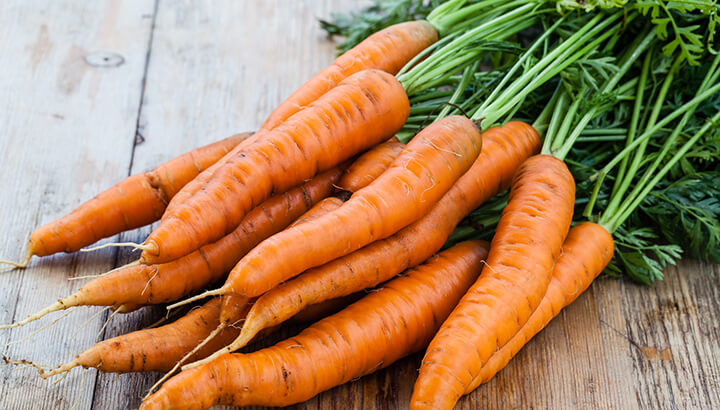
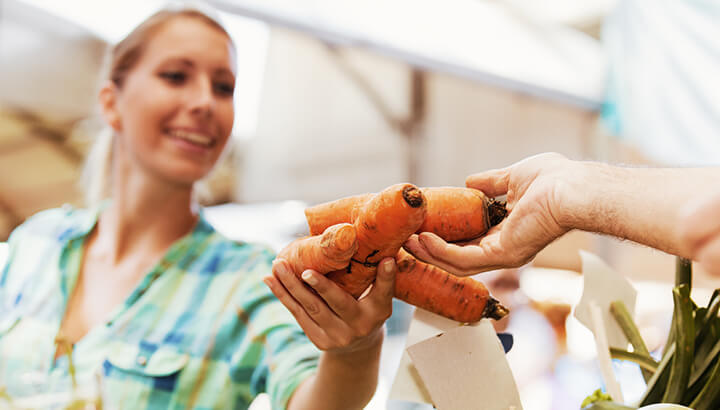
I’m not saying that you need to start growing carrots in your backyard (even though it’s quite fun). I am, however, suggesting an alternative to this quick-and-easy snack. Simply buy whole carrots from your local farmer(s) and cut them yourself. In my opinion, as a society, we spend far too little time in the kitchen. It’s time that we start mending the disconnect between us and our food.
What about nutrition?
The fact of the matter is, our food is becoming more and more manipulated. Not only are we faced with mountains of processed food at the local supermarket, but the way in which our food is grown has also changed. New carrot breeds have been developed. And, when compared to wild carrots, it’s been found that key phytochemicals, such as thymol, are no longer existent.
As we manipulate certain vegetables, their nutritional content begins to dip. As humans, our priorities are out-of-whack — that much is certain. Instead of maintaining a high level of nutrients, companies are more concerned with keeping items on the shelves longer, and in turn, make more money. It’s a sad tale, but we’re certainly not powerless.
Vote with your dollar
Remember, each time you purchase an item, regardless of what it is, you’re essentially voting. Supply and demand are nothing new. If the demand decreases, so will the need to produce. I’m a strong advocate for environmental stewardship. I truly believe that if we all begin to do our part, we can make a much more significant impact.
Begin within your own community and get people talking. Start buying local and get to know your farmers! Although we live in a hectic world, our food supply does not need to be so overly complex. We shouldn’t need to question everything we eat. At the end of the day, we are fortunate that we have a choice.
The takeaway here is, although you will still obtain key nutrients from baby carrots, why would you opt for a less beneficial version? Get into the habit of not only cutting up your own carrot sticks, but also switch it up. Include a range of fresh raw vegetables to snack on. I mean, what’s better than red pepper and hummus?
Let’s go back to basics. Sourcing ingredients that awaken our bodies, while reducing the environmental impact of our choices. After all, as the talented Julia Child once said, “You don’t have to cook fancy masterpieces — just good food, from fresh ingredients.”
— Krista Hillis


I’m confused. You talk about baby carrots and baby-cut carrots as they are the same thing, yet in these sentences you indicate that they are different things entirely:
“After sending imperfect, fully grown carrots through an industrial green bean cutter, then potato peeler, the baby-cut carrot was born.”
“Although you can find baby carrots (essentially very young carrots), they are often slightly less nutritious than fully mature carrots. On the other hand, baby-cut carrots go through quite the harvesting and processing routine.”
ie. baby-cut carrots are simply full grown carrots that have been cut to the size of a baby carrot.
Totally misleading article if you ask me.
If anyone has any brains, they’d grow their own vegetables!
I have got a brain but no garden or facilities to grow vegetables Pity.I would love to.
Okay, so besides the fact that these carrots are washed in a mild chlorine rinse, this article really doesn’t explain what’s so bad about them. The only real negative here is the author’s attitude towards the fact that these carrots are a step or two removed from their entirely natural state. It there is nothing in this article comparing the nutrient value of cut baby carrots to the carrot straight out of the ground. She could’ve been a lot more persuasive with a side by side comparison of food values, but instead she weakens the power of the going-natural argument with broad generalizations.
Container gardening? Can do that even in an apartment
For one they feel slimy compared to regular carrots. That’s what made me stop buying these a bunch of years ago.
Let’s be very clear. There is NO “chlorine” rinse! There may be a rinse with chlorinate water or even with a dilute solution of sodium hypochlorite – household bleach. Learn chemistry! The chemical element Chlorine (Cl2 in its molecular state) is not found in nature by itself. It attaches itself to other elements to form VERY USEFUL chemicals such as hydrochloric acid (HCl) – which is found in high concentrations in our stomach and helps us digest foods. It is also found it common table salt – NaCl – SCARY, right!? It also happens to be used to make bleach which whitens our clothes and kills bacteria. There is no evidence whatsoever that a bacteria-killing bleach rinse will have any harmful effects on the food or on the end users of this food product. The bacteria that is being destroyed definitely CAN have a harmful effect! What would your rather eat – a food that is contaminated by harmful bacteria, or a food that is made safer by a very small amount (ppm levels) of bleach that can be easily rinsed away (if you think you need to)?
Root vegetables do not do well in rocky soil.
I’ve tried growing beans (supposedly and “easy” vegetable). In two years I’ve gotten a grand total of three beans. I thought it might be something about raising from seed, so last year I got some greenhouse-started peppers and eggplants. One eggplant failed to die, but it never got big enough to bear fruit. The only thing I’ve managed to get to harvest size is sage (didn’t do anything the first year, but now it’s self-seeding). Oh, and we’ve got chives up the wazoo. Anybody want some?
Hasn’t worked for me. My “container friendly” peppers and tomatoes all croaked before they got big enough to fruit.
Depends on whether it’s organic or not. And if you’re married to the mainstream viewpoint, what are you doing on an ALTERNATIVE site?
I wash al my fruits and veggies in vinegar and water. Won’t soaking these little critter get the chlorine off? I don’t know I’m asking
There are a lot of foods that get rinsed with chlorine and such. There is chlorine in our tap water, so even if I grew it myself, it would still get rinsed with chlorine.
Are there actually ANY scientific facts or evidence proving that the cleaning process is significantly reducing the nutritional value of the carrots?
Chlorine is an element. So what are these being rinsed with? Sodium chloride? Sodium hypochlorite? Polyvinyl chloride? Anyone that doesn’t mention the actual chemical is not to be trusted!
From your article, does that mean that organic spinach and organic salad mixes are treated with a chlorine rinse, also? Is that one of the rinses in the “triple washed” label on the plastic packaging container???
This lady that wrote this is ridiculous. Does she know how many of her foods are processed like that and it’s a solution of chlorine that is extremely diluted. For fuckssake this was actually debunk as far as being bad a few years ago. Get out of your bubble and chew on your lead pencil a bit lady.
Do you know, or does it vary by vendor?
I don’t know, nor do I really care. I freaking love sodium chloride. Even it they were rinsed in a mild bleach solution, I wouldn’t care. I have ingested so much chlorine during my time as a lifeguard… The crux of her argument is that “chemicals are bad”, and I hate ignorant arguments like that. Might as well avoid dihydrogen monoxide and diatomic oxygen if you are worried about chemicals.